How a Japanese Tea Garden Snack Fooled America Into Thinking It Was Chinese
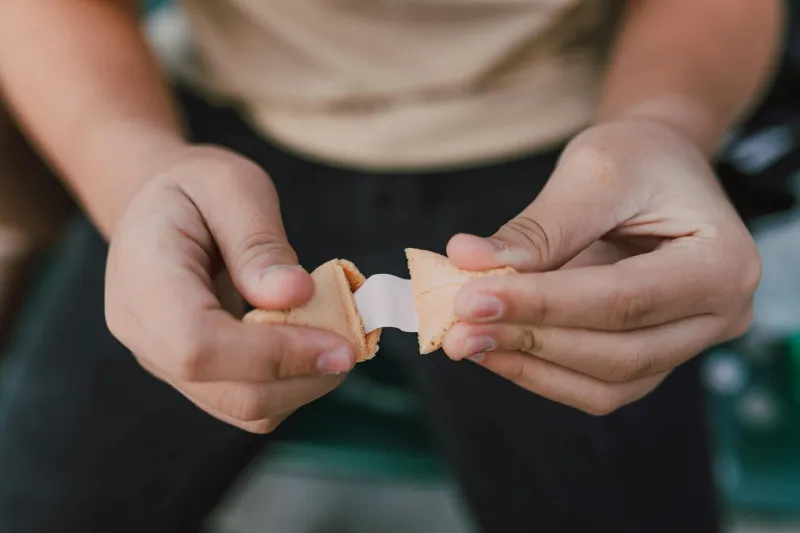
The Cookie That Started a Cultural Mix-Up
Walk into any Chinese-American restaurant from Boston to Seattle, and you'll leave with a fortune cookie. It's as predictable as soy sauce packets and chopsticks wrapped in paper. But here's the twist that would make Confucius scratch his head: fortune cookies aren't Chinese. They're not even American in the way we think of American food. They're Japanese — created by Japanese immigrants who probably never imagined their tea garden treat would become the calling card of an entirely different cuisine.
The fortune cookie is food history's greatest case of mistaken identity, and the story of how it happened reveals everything about how immigrant communities shape American eating habits in ways that would surprise everyone involved.
A Garden Party Snack Goes Rogue
In the early 1900s, Japanese immigrants in California were running tea gardens — peaceful spots where visitors could sip tea and nibble on light refreshments while strolling through carefully maintained landscapes. These weren't restaurants in the modern sense, but rather cultural experiences that offered Americans a taste of Japanese hospitality.
At these tea gardens, particularly in San Francisco and Los Angeles, visitors received small, folded cookies with strips of paper tucked inside. The papers contained brief messages — sometimes fortunes, sometimes thank-you notes, sometimes just pleasant thoughts. The cookies themselves were based on a traditional Japanese confection called tsujiura senbei, which had been served at temples and festivals in Japan for generations.
The Japanese bakers who made these cookies for California tea gardens were simply recreating a familiar tradition from home. They had no master plan to revolutionize American dining. They were just trying to make a living while sharing a piece of their culture with curious Americans.
When World War II Changed Everything
Then came December 7, 1941, and everything shifted overnight. Executive Order 9066 forced Japanese Americans into internment camps, shuttering businesses and scattering communities. The tea gardens closed. The families who ran them lost everything. But their cookies didn't disappear — they just found new hands.
Chinese-American restaurant owners, who had been familiar with the cookies through their Japanese neighbors and competitors, stepped in to fill the void. It made business sense: Americans had grown fond of these little cookies with messages inside, and Chinese restaurants were already serving dessert to round out their meals.
What started as a practical business decision became a permanent cultural adoption. Chinese-American restaurants began serving fortune cookies as if they'd always been part of the tradition. Most diners never questioned it — why would they? The cookies came from Asian restaurants, so they must be Asian. The specific origins didn't matter to customers who just enjoyed the ritual of cracking open their cookie and reading their fortune.
The Great Export Experiment
By the 1960s and 70s, fortune cookies had become so thoroughly associated with Chinese-American dining that something remarkable happened: American companies started exporting them back to Asia as authentic Chinese treats. Food manufacturers shipped containers of fortune cookies to Hong Kong, Taiwan, and mainland China, marketing them as traditional Chinese desserts that had somehow been lost to history.
The reaction in China was exactly what you'd expect: confusion. Chinese diners treated fortune cookies as a novelty American import, which, in a roundabout way, they were. The cookies had been invented by Japanese immigrants, adopted by Chinese-American restaurants, mass-produced by American companies, and then shipped back to Asia as Chinese food. It was cultural telephone played with industrial efficiency.
Even today, if you visit China and find fortune cookies, they're usually marketed as American treats. The irony is perfect: a Japanese tradition became Chinese-American, then became American-Chinese, then became American again.
What This Says About American Food
The fortune cookie's confused identity tells us something important about how food culture actually works in America. We like to think of ethnic cuisines as pure traditions passed down unchanged from the old country, but the reality is much messier and more interesting.
Chinese-American food, like most immigrant cuisines in America, adapted to local tastes, available ingredients, and business necessities. Fortune cookies fit perfectly into this evolution — they were Asian enough to feel authentic, American enough to satisfy local preferences, and practical enough to work in a restaurant setting.
The fact that they weren't originally Chinese didn't matter because authenticity in American immigrant food has always been more about meeting expectations than preserving traditions. Chinese-American restaurants were already serving dishes that would be unrecognizable in China. Adding fortune cookies to the mix was just another adaptation in a long line of practical compromises.
The Cookie That Belongs to Everyone and No One
Today, fortune cookies exist in a cultural limbo that somehow makes perfect sense. They're not authentically Chinese, Japanese, or American — they're authentically Chinese-American, which is its own legitimate tradition built from the experiences of immigrants adapting their cultures to a new country.
The Japanese immigrants who first served these cookies at California tea gardens were doing exactly what immigrants have always done: taking something from home and reshaping it to work in their new environment. The Chinese-American restaurant owners who adopted the cookies were doing the same thing. And the American companies that mass-produced and exported them were just completing the circle.
Every time you crack open a fortune cookie, you're participating in one of the most perfectly American food traditions imaginable — a tradition that started somewhere else, got adopted by someone else, and ended up belonging to everyone involved. That confusion isn't a bug in the system. It's the feature that makes American food culture so endlessly creative and surprisingly honest about how cultures actually mix in the real world.