The Numbers on Your Canned Goods Are Not What You Think They Are
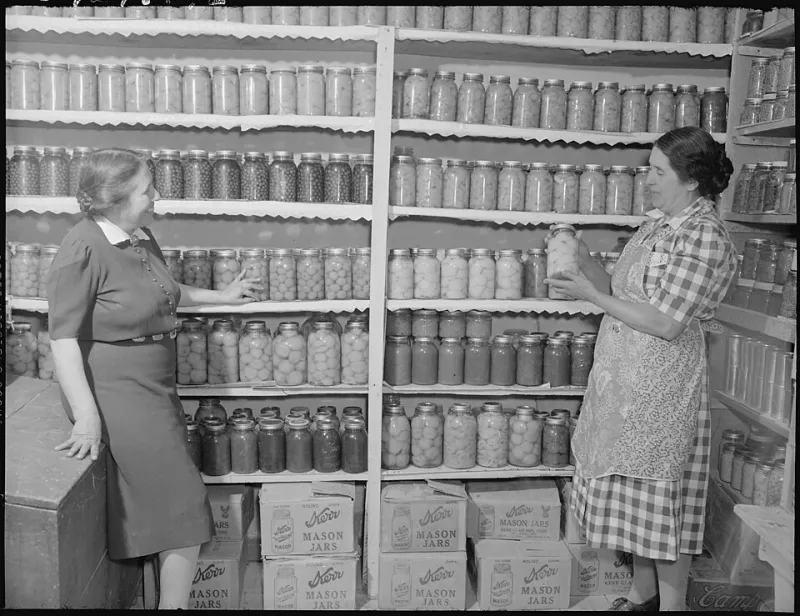
Photo: The U.S. National Archives, No restrictions, via Wikimedia Commons
Open your pantry right now. Pick up a can of beans, a can of tomatoes, or a can of chicken broth. Find the date stamped on the bottom. Now ask yourself: what does that date actually mean?
If your answer involves the words "safe" or "expired," you've fallen for one of the quietest and most effective pieces of marketing in American food history. That date on your canned goods is not a safety guideline. It is not a federal regulation. In most cases, it is not even a particularly educated guess. It is, at its core, a suggestion — invented by the food industry, for the food industry, that somehow became mistaken for law.
Canning Was Designed to Make Food Last Forever (Almost)
To understand why this matters, you have to understand what canning actually does to food. The process was developed in the early 1800s after Napoleon Bonaparte offered a cash prize to anyone who could figure out how to feed his army on long campaigns. A French chef named Nicolas Appert discovered that sealing food in airtight containers and heating them prevented spoilage — though he didn't fully understand why at the time. Louis Pasteur would later explain the science: heat kills the microorganisms that cause food to rot.
 Photo: Louis Pasteur, via 64.media.tumblr.com
 Photo: Nicolas Appert, via image.makewebeasy.net
 Photo: Napoleon Bonaparte, via as2.ftcdn.net
When a can is properly sealed and heat-processed, the food inside is essentially isolated from the outside world. No new bacteria can get in. The existing bacteria have been destroyed. The food doesn't "go bad" in the traditional sense — it may slowly change in texture or lose some nutritional value over time, but it doesn't become dangerous to eat the way that raw meat or fresh produce does.
Cans recovered from 19th-century shipwrecks have been opened and found to still be technically edible. Military rations from World War II have been tested and found safe decades later. The U.S. Army has studied canned food stored at room temperature for years and found it remained nutritionally adequate and microbiologically safe well beyond any date printed on the label.
So where did the dates come from?
A Voluntary System That Became Invisible Law
In the early 1970s, American consumers were becoming more label-conscious. The organic food movement was gaining ground. People were starting to ask questions about what was in their food and how fresh it was. Grocery stores, responding to customer demand, began asking manufacturers to put some kind of date on their products.
Here's the critical detail: there was no federal standard for what those dates should mean. The FDA did not step in and define "best by" versus "use by" versus "sell by." The USDA did not create a uniform system. Instead, individual manufacturers developed their own voluntary guidelines, often working through industry trade groups, and stamped whatever date they felt was appropriate on their products.
For canned goods specifically, manufacturers typically chose dates that reflected peak quality — the window during which they were confident the product would taste exactly as intended — rather than the much longer window during which it would remain safe. A can of soup might be stamped with a date two years out, not because it becomes dangerous after two years, but because the manufacturer didn't want to be associated with a product that had lost some of its texture or color, even if it was still perfectly edible.
The result was a system that looked official, felt regulatory, and had almost no legal teeth.
The Waste That Followed
Americans, reasonably assuming that dates on food packaging meant something concrete, began throwing things away when those dates passed. This was not irrational behavior — it was a logical response to a system that was designed to look authoritative. The problem is that the system was never built around safety. It was built around brand perception.
The numbers are staggering. The Natural Resources Defense Council has estimated that American families throw away somewhere between $1,300 and $2,200 worth of food per year. A significant portion of that waste is driven by date confusion — people discarding food that is past its printed date but nowhere near actually spoiled. Canned goods, which can safely last years beyond their stamped dates, are a major part of this equation.
Food banks and hunger relief organizations have long dealt with a particularly painful version of this problem: donated canned goods that are turned away because they're past their printed dates, even when the contents are entirely safe to eat. Some states have passed laws specifically to address this, allowing food banks to distribute canned goods past their stamped dates. The fact that such laws were necessary says everything about how thoroughly the voluntary manufacturer date became mistaken for a safety standard.
What the Labels Actually Mean — When They Mean Anything
The terminology itself is a maze. "Best by" typically refers to peak quality. "Use by" is often used for perishables and carries more genuine urgency. "Sell by" is primarily a stock management tool for retailers. None of these phrases are federally standardized for most products — though the USDA does regulate date labels on meat and poultry.
For canned goods specifically, the FDA has stated clearly that canned food can be safe indefinitely as long as the can is in good condition — no rust, no dents on the seams, no swelling, no unusual odor when opened. The date on the bottom is a quality estimate, not a safety countdown.
The Pantry Audit You've Been Avoiding
None of this means you should be reckless. A bulging can is a real warning sign. A can that hisses or spurts when opened deserves caution. These are the actual indicators of a problem — not a date that a manufacturer's marketing team decided looked appropriately conservative in 1978.
The dates on your canned goods are not a lie, exactly. They're just not the truth you've been assuming they were. They're a suggestion from a company that wanted you to feel confident about their product — and, not coincidentally, to buy a new can sooner than you strictly needed to.
Your pantry is probably full of food that's perfectly fine. The number on the bottom just doesn't want you to know that.