When Monks Twisted Dough Into Prayers: How a Sacred Snack Became America's Stadium Food
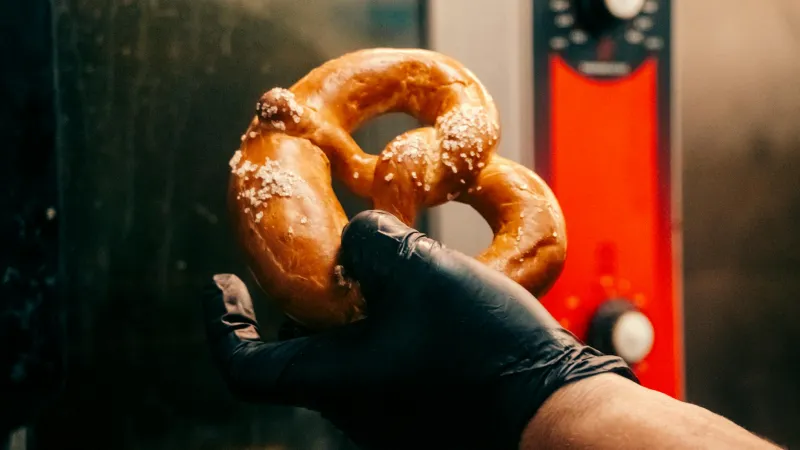
The next time you're at a baseball game, unwrapping a warm pretzel from its paper sleeve, you're holding something that was once considered sacred. That twisted knot of dough didn't start its life in stadium kitchens or shopping mall stands — it began in the quiet stone chambers of European monasteries, where robed monks carefully shaped each loop as a reward for children who could recite their prayers from memory.
The Original Prayer Snack
Sometime around 610 AD, in what's now France or Northern Italy, a creative monk was looking for a way to motivate young students learning their catechism. Children struggled to memorize Latin prayers, and the monk needed an incentive that would stick. So he took leftover scraps of bread dough, rolled them into thin ropes, and twisted them into a distinctive shape that mimicked the way people folded their arms across their chest in prayer.
He called his creation "pretiola" — Latin for "little reward." The three holes formed by the twisted dough weren't accidental design choices. They represented the Holy Trinity, while the crossed arms symbolized the proper posture for prayer. Every bite was supposed to remind children of their devotional lessons.
The monk's edible teaching aid caught on faster than he probably expected. Other monasteries started making their own versions, and the recipe spread across medieval Europe like wildfire. By the 12th century, pretzel-making had become so associated with religious life that the Catholic Church gave bakers official permission to make them during Lent, when many other foods were forbidden.
From Sacred Symbol to Street Food
But something funny happens when you make a food both delicious and meaningful — people start caring more about the delicious part. Medieval Europeans began eating pretzels not just as religious rewards, but as regular snacks. Street vendors started selling them at markets. German bakers, who had perfected the art of pretzel-making, began experimenting with different sizes, from tiny finger-food versions to massive loaves that could feed a family.
The pretzel's religious symbolism gradually faded into background noise. By the time German immigrants started arriving in America in the 1700s and 1800s, most people who made and ate pretzels had forgotten entirely about the monk's original spiritual intentions. They just knew they had a twisted bread that tasted great with beer and salt.
The Great American Transformation
German settlers brought their pretzel-making skills to Pennsylvania, where the snack found its most devoted American following. Philadelphia became the unofficial pretzel capital of the New World, with German bakeries setting up shop and adapting their recipes to local tastes and ingredients.
But the real transformation happened when American entrepreneurs figured out how to mass-produce what had always been a handmade item. In the early 1900s, mechanical pretzel-twisting machines replaced the careful hand-shaping that monks had perfected over centuries. What took a baker several minutes to twist by hand could now be stamped out in seconds.
The industrialization of pretzel-making stripped away the last vestiges of the snack's sacred origins. Machine-made pretzels were perfectly uniform, efficiently salted, and completely divorced from any religious meaning. They were just twisted bread — cheap, portable, and perfect for American appetites.
Stadium Snacks and Shopping Mall Stands
By the mid-20th century, pretzels had completed their journey from monastery to mainstream. Vendors started selling them at baseball games, where the twisted shape made them easy to hold with one hand while cheering with the other. Shopping malls discovered that pretzel stands could fill their corridors with an irresistible aroma that drew customers from across the food court.
The soft pretzel, warmed and served with mustard or cheese, became as American as hot dogs or popcorn. Chains like Auntie Anne's turned pretzel-making into a retail empire, with locations in airports, malls, and street corners across the country. The original monk's "little reward" had become a multimillion-dollar industry.
The Prayer You Can't See
Today, Americans consume over 2.8 billion pretzels annually, and almost none of them know they're eating a prayer. The three holes that once represented the Trinity are just convenient spaces for salt to collect. The crossed arms that symbolized devotion are simply the most efficient way to twist dough into an appealing shape.
It's a perfect example of how food evolves — taking a form that once had deep spiritual meaning and transforming it into something purely practical and delicious. That medieval monk who first twisted dough to teach children about prayer probably never imagined his creation would end up in the hands of baseball fans, shopping mall browsers, and airport travelers.
But maybe there's something fitting about a snack that was designed to be a "little reward" becoming exactly that for millions of Americans who've never heard its origin story. Every pretzel is still, in its own way, a small treat for getting through the day — even if the prayers that earned it have long since been forgotten.