The Lunch Break Is Barely a Century Old — And It Might Already Be Disappearing
The Lunch Break Is Barely a Century Old — And It Might Already Be Disappearing
For most working Americans, the lunch break is just part of the day. You stop what you're doing around noon, eat something, maybe step outside or scroll your phone for twenty minutes, and then get back to it. It feels like a natural rhythm — almost biological, like the body just knows it's time to pause.
But that midday pause isn't natural at all. It's a construction. A relatively recent one, shaped by factory floors, labor organizers, time-motion studies, and a very specific set of ideas about productivity that took hold in the early twentieth century. Before all of that, the concept of a scheduled break in the middle of the workday — a standardized, employer-acknowledged pause specifically for eating — simply didn't exist in the way we know it.
And now, quietly, it may be coming undone.
How People Ate Before the Lunch Break Existed
For most of human history, the rhythm of eating tracked the rhythm of the sun and the work itself. Agricultural laborers ate when there was a natural pause — when the animals needed rest, when the light shifted, when the task at hand reached a stopping point. Meals happened at home, with family, governed by the household rather than an employer.
Even into the early industrial era in America, the midday meal was often taken at home. Many factories and workshops in the 1800s were close enough to residential neighborhoods that workers could walk back for a meal and return. The concept of a "lunch pail" — workers bringing food from home to eat on-site — only became widespread as factories grew larger, shifted to the outskirts of cities, and made that walk home impractical.
But this was still informal. There was no standardized break time, no universal policy, no guarantee that you'd get any pause at all. In many cases, workers ate while continuing to work, or grabbed something during a brief, unscheduled lull. The idea that an employer owed workers a defined midday break was not yet part of the American labor conversation.
The Factory Clock Changed Everything
The industrial revolution didn't just change what Americans did for work. It changed how time itself was experienced. Factory production ran on schedules — shift start times, output quotas, coordinated machinery that couldn't stop and start on individual human whims. For the first time in history, large numbers of people had their daily lives organized not by natural rhythms or personal choice, but by a clock on a wall and a whistle on the factory floor.
In this context, the lunch break emerged not as a concession to workers' wellbeing, but as an operational necessity. Machines needed maintenance. Workers needed to eat. A brief, scheduled pause made the rest of the shift more efficient. Early time-motion researchers — the same people who gave us the efficiency obsessions of the early 20th century — actually advocated for structured breaks on the grounds that rested workers were more productive workers. The lunch break, in other words, was initially as much about output as it was about humanity.
Labor movements pushed for something more. Through the late 19th and early 20th centuries, unions fought hard for defined work hours, safer conditions, and the right to actually stop working during the day. The Fair Labor Standards Act of 1938 didn't mandate paid lunch breaks — federal law still doesn't, technically — but the cultural and contractual expectation of a midday break had, by mid-century, become deeply embedded in American working life.
The Office Lunch and the Rise of Lunch Culture
As manufacturing gave way to office work across the postwar decades, the lunch break transformed again. The power lunch became a cultural institution — deals made over steaks in midtown Manhattan, business relationships built across white tablecloths. For white-collar workers, lunch wasn't just eating; it was networking, hierarchy, performance.
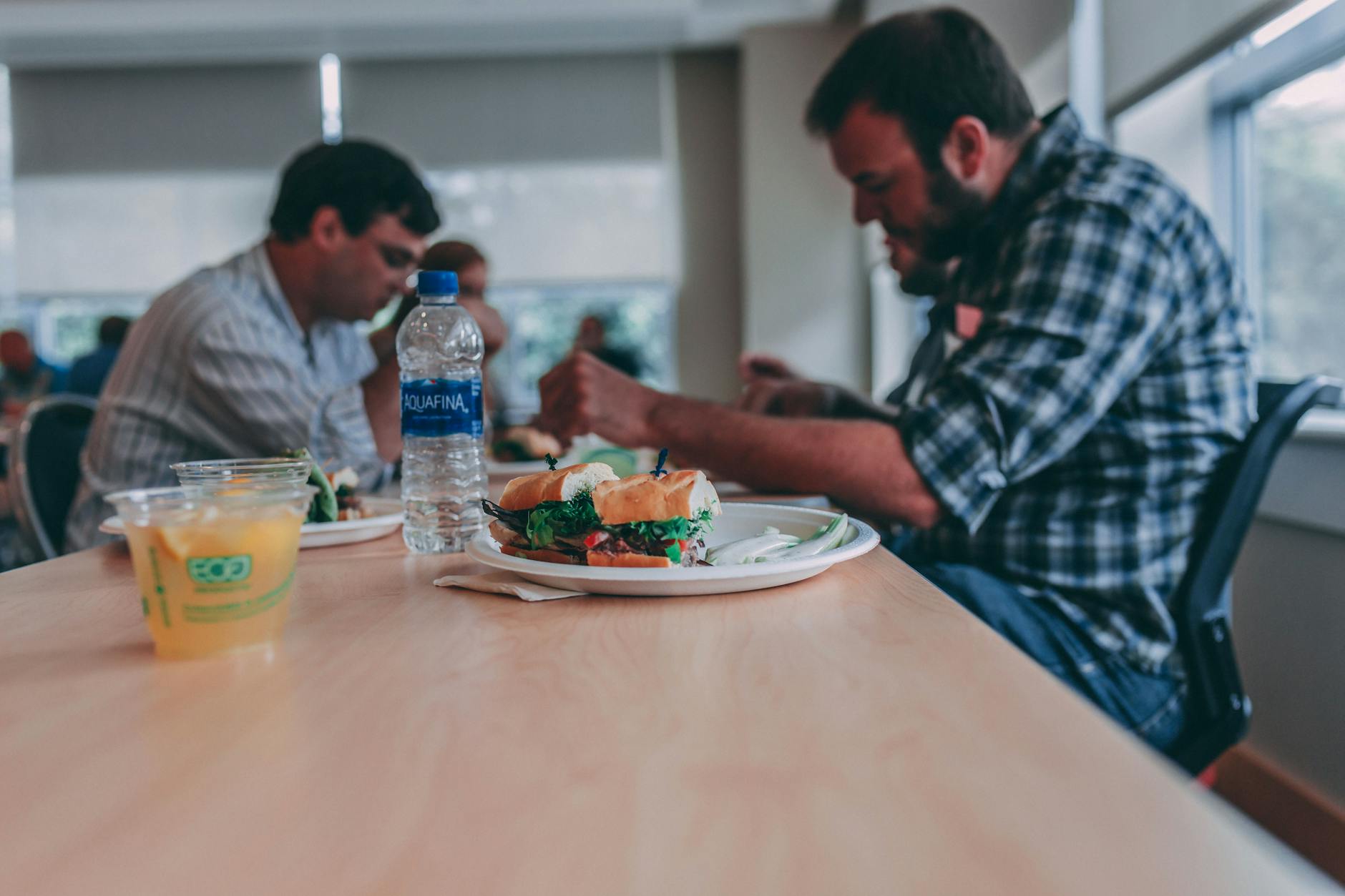
For everyone else, it was a sandwich at a deli counter, a slice of pizza eaten standing up, a brown bag at a breakroom table. The specifics varied enormously by industry, income, and geography, but the basic structure held: you worked the morning, you stopped at noon, you ate, you went back.
American food culture built itself around that rhythm. The diner, the lunch counter, the fast food drive-through, the office cafeteria — all of these were designed for the working lunch break. Entire industries exist specifically because millions of people need to eat a hot meal in under forty-five minutes at roughly the same time every weekday.
The Pandemic Quietly Dismantled the Ritual
And then, in March 2020, most of it stopped.
When millions of American workers shifted to remote work almost overnight, the structured lunch break dissolved for a huge portion of the workforce. Without a commute, without an office, without colleagues to eat with or a nearby sandwich shop to walk to, the midday pause became formless. Some people ate earlier. Some ate later. Many ate at their desks while continuing to work — a pattern that surveys suggest became the norm for remote workers across the country.
What's emerged since isn't a clean story. Some workers have found that flexible remote schedules actually allow for a better midday break — a real walk, a home-cooked meal, time with family. Others have found that without the hard stop that an office environment provides, lunch simply disappears into the workday, replaced by a granola bar at 2 p.m. and a vague sense that something is off.
The lunch break was invented by industrial capitalism for industrial capitalism's purposes. It survived long enough to become a ritual, a social institution, a cultural given. Whether it survives the current restructuring of American work — the remote revolution, the gig economy, the blurring of work and home — is genuinely unclear.
For now, though, somewhere around noon, most of us still feel it: that pull toward a pause, a plate, a moment to step back from whatever the morning threw at us. Some habits run deeper than the systems that created them.