The Devil's Little Pitchfork: How America's Most Essential Utensil Was Once Banned from Christian Tables
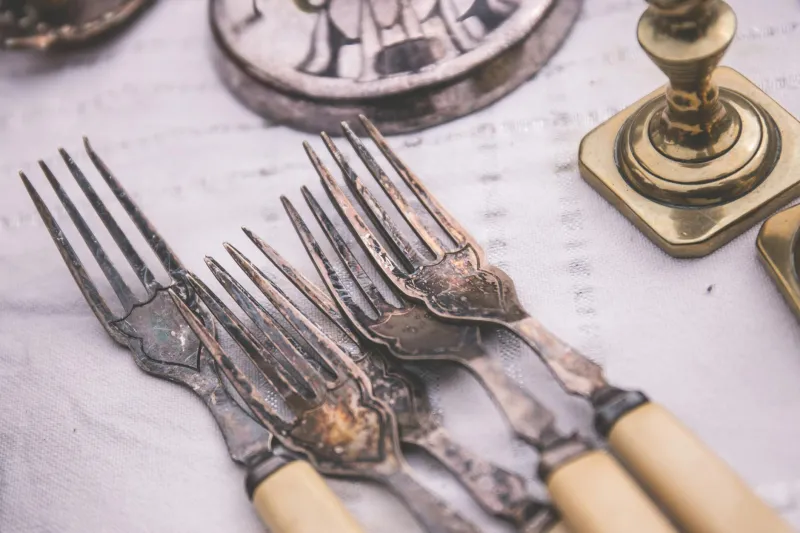
The Unholy Invention That Horrified Medieval Europe
Picture this: You're sitting down to dinner in 11th-century Europe, and someone pulls out what looks like a tiny pitchfork to spear their meat. The reaction wouldn't be curiosity—it would be horror. Church leaders would declare you a heretic, your neighbors would whisper about your soul, and you'd likely be accused of doing the Devil's work right there at the dinner table.
That "demonic" tool? The humble fork that now sits beside every plate in America.
When Byzantine Princess Maria Argyropoulina married the son of a Venetian doge around 1004 AD, she brought more than just diplomatic ties to Italy. She brought a strange eating implement: a small, two-pronged golden fork. Venetian society was scandalized. Here was a woman who refused to touch her food with the hands God gave her, instead using what clergy immediately dubbed "an instrument of the Devil."
The backlash was swift and merciless. When the princess died of plague just two years later, local priests declared it divine punishment for her prideful rejection of God's natural design. The message was clear: fingers were sacred, forks were sacrilegious.
Why God's Own Fingers Weren't Good Enough
The medieval church's opposition to forks went deeper than simple suspicion of foreign customs. In their theology, God had perfectly designed human hands for eating. To use an artificial tool suggested that divine creation was somehow inadequate—a form of blasphemy that struck at the heart of Christian doctrine.
"God in his wisdom has provided man with natural forks—his fingers," thundered Saint Peter Damian, a prominent 11th-century monk. "Therefore it is an insult to Him to substitute artificial metallic forks for them when eating."
Beyond theological concerns, the fork's resemblance to the Devil's pitchfork made it an easy target for superstition. Medieval art consistently depicted Satan wielding a three-pronged trident, and the fork's similar shape seemed like an obvious connection to evil forces. Using one at dinner felt dangerously close to inviting demonic influence into the home.
For centuries, this religious opposition kept forks firmly out of European dining rooms. Even wealthy nobles who could afford such luxuries avoided them, preferring to maintain their spiritual reputations rather than risk accusations of heresy.
The Slow March Toward Respectability
The fork's rehabilitation took nearly 600 years. By the 1600s, French and Italian courts had begun embracing the utensil as a mark of sophistication rather than sin. But even then, adoption was painfully slow.
English society remained particularly resistant. When Thomas Coryate wrote about encountering forks during his travels through Italy in 1608, his countrymen mocked him mercilessly. They dubbed him "Furcifer" (fork-bearer) and treated his advocacy for the utensil as a laughable foreign affectation.
It wasn't until the late 1600s that forks gained any real acceptance in England, and even then, they were considered effeminate. "Real men" ate with their knives and fingers—forks were for delicate ladies who couldn't handle proper food.
How America Embraced the Devil's Utensil
When European immigrants began flooding into America during the 1800s, they brought their evolving table manners with them. Suddenly, the fork wasn't just a utensil—it became a symbol of civilization itself.
American etiquette reformers of the 19th century seized on the fork as a way to distinguish refined society from frontier barbarism. Books like "The American Chesterfield" (1827) and "The Canons of Good Breeding" (1839) made fork usage a cornerstone of proper behavior. To eat without a fork wasn't just poor manners—it marked you as uncivilized, possibly even un-American.
This transformation happened remarkably quickly. Within two generations, the same tool that medieval priests had condemned as Satanic became essential for anyone seeking social acceptance in American society. Boarding houses posted rules requiring fork usage, finishing schools drilled proper technique, and mothers taught their children that fork skills were as important as reading and writing.
The Industrial Revolution accelerated this change. Mass production made forks affordable for ordinary families, while the growth of restaurants and formal dining establishments made proper utensil use a practical necessity. By 1900, any American who couldn't handle a fork properly faced social embarrassment and professional limitations.
From Sin to Symbol
Today, the fork's journey from forbidden fruit to dinner table essential reflects something deeper about American culture. We took a European symbol of refinement and made it democratic—available to everyone, expected from everyone.
The same utensil that once marked the boundary between sacred and profane now marks the boundary between civilized and crude. We've forgotten its scandalous origins entirely, turning the Devil's pitchfork into the most American of tools: practical, universal, and utterly essential.
Every time you pick up a fork, you're participating in a 1,000-year rebellion against medieval theology. Not bad for something that once threatened your eternal soul.